
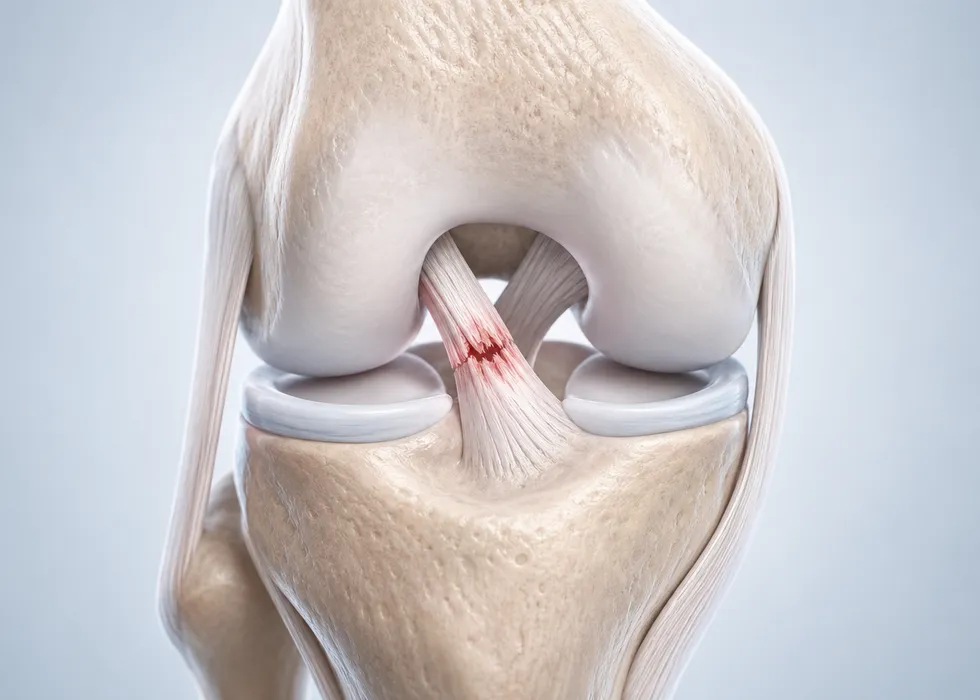
The anterior cruciate ligament, or ACL, is one of the main stabilizing ligaments of the knee. It prevents excessive forward movement of the tibia and helps control rotational stability during cutting, pivoting, deceleration, and landing. When it tears, patients often experience instability rather than just pain.
How ACL Tears Happen
ACL injuries occur both in contact and non-contact settings. In many sports, the tear happens without direct impact. A typical mechanism includes:
- Sudden deceleration
- Pivoting on a planted foot
- A change of direction with the knee collapsing inward
- Landing from a jump with poor control
Patients frequently report hearing or feeling a pop at the moment of injury. Swelling often develops quickly because the ligament tears inside the joint and bleeding occurs into the knee.
Symptoms That Raise Concern
The most common signs are:
- Immediate swelling after a twisting injury
- Deep knee pain
- Loss of confidence when turning or pivoting
- A feeling that the knee “gives way”
- Difficulty returning to sport
Even if walking becomes possible after the first few days, functional instability can persist. That is why improvement in pain alone does not rule out a significant ligament injury.
Evaluation and Imaging
Diagnosis combines history, physical examination, and imaging. Tests such as the Lachman test, anterior drawer, and pivot shift help determine how much instability is present. MRI is commonly used to confirm the ligament tear and to look for associated injuries such as:
- Meniscus tears
- Cartilage damage
- Bone bruising
- Additional ligament injuries
Associated damage matters because treatment decisions are based not only on the ACL itself, but also on the overall condition of the knee.
Is Surgery Always Necessary?
Not every ACL tear requires immediate reconstruction. The right treatment depends on the patient’s activity level, instability symptoms, associated injuries, and goals.
Non-operative treatment
Conservative management may be reasonable when:
- The patient has low pivoting demands
- The knee remains functionally stable
- There is no major associated meniscus or cartilage injury
- The individual is committed to rehabilitation
Treatment focuses on swelling control, regaining motion, strengthening the quadriceps and hamstrings, and neuromuscular training. Some patients return successfully to daily life and selected sports without surgery.
Surgical reconstruction
ACL reconstruction is commonly recommended in younger or highly active patients, especially when the knee repeatedly gives way or when the patient wants to return to pivoting sports. Reconstruction uses a graft, typically from hamstring, patellar tendon, or quadriceps tendon tissue, to restore stability.
Surgery aims to:
- Improve knee stability
- Protect the meniscus and cartilage from repeated episodes of giving way
- Support return to sport when appropriate
Recovery Is More Than Healing the Graft
Rehabilitation is central to success. Before surgery, it is often important to reduce swelling and recover motion. After reconstruction, recovery usually progresses through structured phases:
- Protecting the knee and controlling swelling
- Restoring full extension and improving flexion
- Rebuilding strength
- Restoring balance, control, and impact tolerance
- Advancing to running and sport-specific drills
Return to sport should not be based on the calendar alone. Strength symmetry, functional testing, movement quality, and confidence all matter.
Long-Term Perspective
An ACL tear is not just a short-term sports injury. Recurrent instability can lead to secondary meniscus and cartilage damage, and even a well-treated knee may have an increased long-term risk of degenerative change. Accurate diagnosis, patient-specific treatment, and disciplined rehabilitation are essential for the best outcome.