
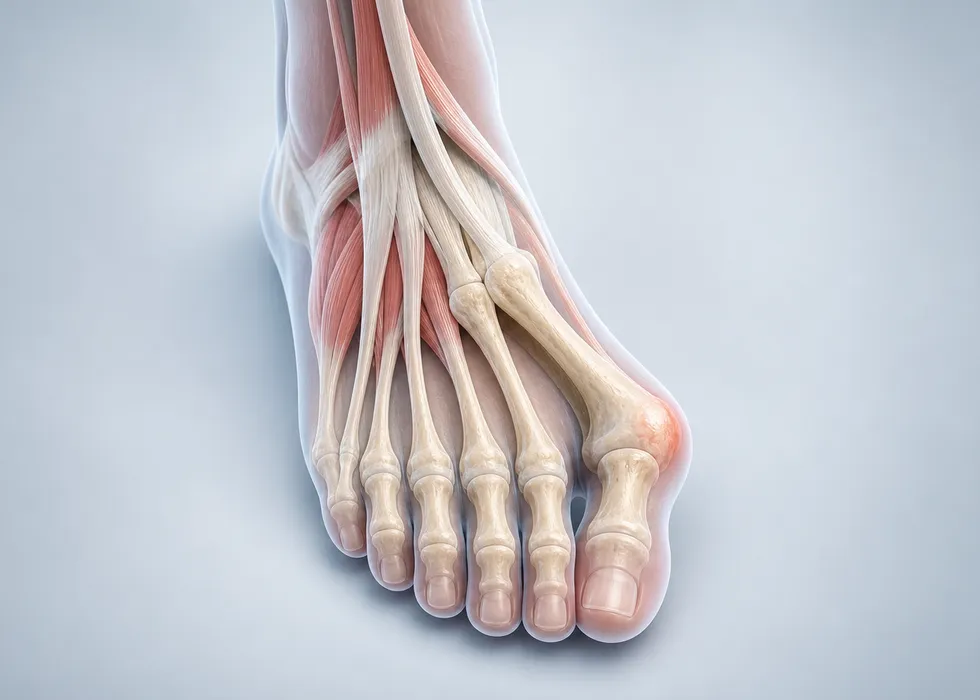
Hallux valgus, often called a bunion, is not simply a bony bump on the side of the foot. It is a progressive deformity of the first ray in which the big toe drifts toward the lesser toes while the first metatarsal shifts in the opposite direction. Over time, this changes weight transfer, footwear tolerance, and walking mechanics.
Why the Deformity Develops
Hallux valgus usually results from a combination of inherited anatomy and long-term mechanical stress. Common contributing factors include:
- Family history
- Ligament laxity
- Flatfoot or other alignment issues
- Inflammatory joint disease
- Narrow or high-heeled footwear that increases forefoot pressure
Footwear alone does not explain every case, but shoe shape can accelerate symptoms and make the deformity more noticeable.
Symptoms Beyond the “Bump”
Patients may present with:
- Pain over the medial prominence
- Redness and irritation from shoe pressure
- Difficulty fitting into regular footwear
- Transfer pain under the lesser toes
- Overlapping or crowding of neighboring toes
As the first toe loses its normal alignment and function, the rest of the forefoot often carries load less efficiently. This is why symptoms may extend beyond the bunion itself.
Clinical and Radiographic Assessment
Evaluation includes gait pattern, first toe motion, skin irritation, callus formation, and the position of the lesser toes. Weight-bearing radiographs are particularly important because they show the true angular deformity under load.
Imaging helps assess:
- Hallux valgus angle
- Intermetatarsal angle
- Joint degeneration
- Sesamoid displacement
- Associated lesser toe deformity
The severity on X-ray does not always match the severity of symptoms, so treatment decisions should be based on both structure and function.
Conservative Treatment
Non-surgical treatment does not reverse the deformity, but it can reduce symptoms. Helpful measures may include:
- Wider toe-box shoes
- Forefoot padding
- Activity and footwear modification
- Orthotic support in selected patients
- Anti-inflammatory measures during flare-ups
These strategies aim to improve comfort, not to straighten the toe permanently.
When Surgery Is Considered
Surgery becomes more relevant when pain persists despite appropriate shoe modification or when deformity significantly limits daily life. There is no single operation for every bunion. The procedure depends on:
- Severity of angular deformity
- Flexibility of the deformity
- Joint degeneration
- First ray instability
- Associated lesser toe problems
Possible techniques include soft tissue balancing, osteotomy of the first metatarsal or proximal phalanx, and, in selected cases, fusion procedures.
Recovery and Expectations
Recovery depends on the procedure performed. Swelling can last for months even after a technically successful correction. The goals of treatment are pain reduction, better shoe wear, improved alignment, and functional improvement. A realistic plan should also include discussion of recurrence risk, stiffness, or continued footwear limitations in some patients.