
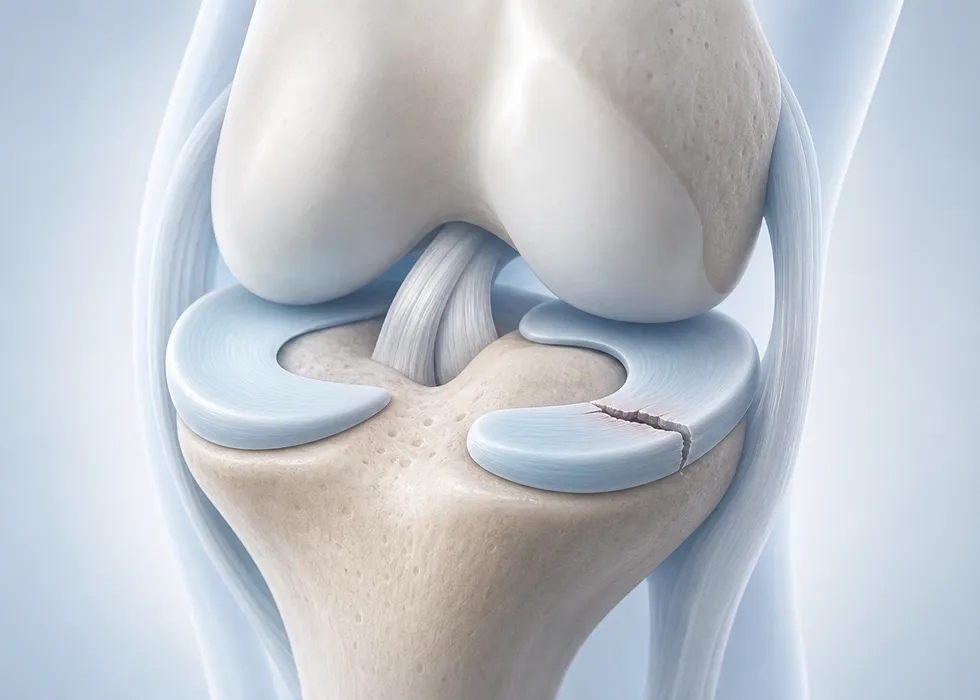
The meniscus is a shock-absorbing cartilage structure inside the knee. Each knee has a medial and a lateral meniscus, and both help distribute load, improve stability, and protect the articular cartilage. When a meniscus tears, the knee may become painful, swollen, mechanically limited, or less reliable during daily activity and sport.
How Meniscus Tears Occur
Meniscus tears occur in two broad patterns:
- Traumatic tears, often in younger or athletic patients after twisting on a planted knee
- Degenerative tears, more common with age and cartilage wear
The exact pattern matters because a stable degenerative tear is not treated the same way as an unstable traumatic tear in a previously healthy knee.
Symptoms
Common complaints include:
- Joint-line pain
- Swelling after activity
- Locking or catching
- Pain with squatting or twisting
- A sense that the knee is not moving smoothly
Not every meniscus tear produces dramatic symptoms. Some small tears are found on MRI but do not explain the patient’s pain. Clinical correlation is essential.
Diagnosis
History and examination remain central. Pain location, twisting mechanism, swelling pattern, and mechanical symptoms all help guide suspicion. MRI is frequently used to confirm the tear pattern and identify associated injuries such as ligament damage or cartilage wear.
The main questions are:
- Is the tear stable or unstable?
- Is it traumatic or degenerative?
- Is it repairable?
- Is it actually the source of symptoms?
When Non-Surgical Care Makes Sense
Many degenerative or stable tears improve with conservative treatment. A typical plan may include:
- Activity modification
- Swelling control
- Strengthening and mobility exercises
- Gradual return to tolerated loading
The goal is to improve function and reduce pain without removing useful meniscal tissue unnecessarily.
When Surgery Is Considered
Surgery becomes more relevant when there is persistent mechanical locking, ongoing instability, failure of structured rehabilitation, or a tear pattern that is more likely to heal if repaired early. In general, meniscus preservation is preferred whenever possible.
Meniscus repair
Repair is often favored in younger patients, traumatic tears, and tear patterns located in better-vascularized zones. The goal is to preserve meniscal function for long-term joint protection.
Partial meniscectomy
If the torn segment cannot be repaired, limited trimming may be considered. The key principle is to remove as little tissue as necessary, because excessive meniscus loss increases long-term joint stress.
Recovery Principles
Recovery depends on the treatment chosen. After repair, rehabilitation is usually more protective and slower because the tissue needs time to heal. After partial meniscectomy, the timeline can be faster, but the long-term goal remains the same: restore control, strength, and loading tolerance without provoking repeated swelling.