
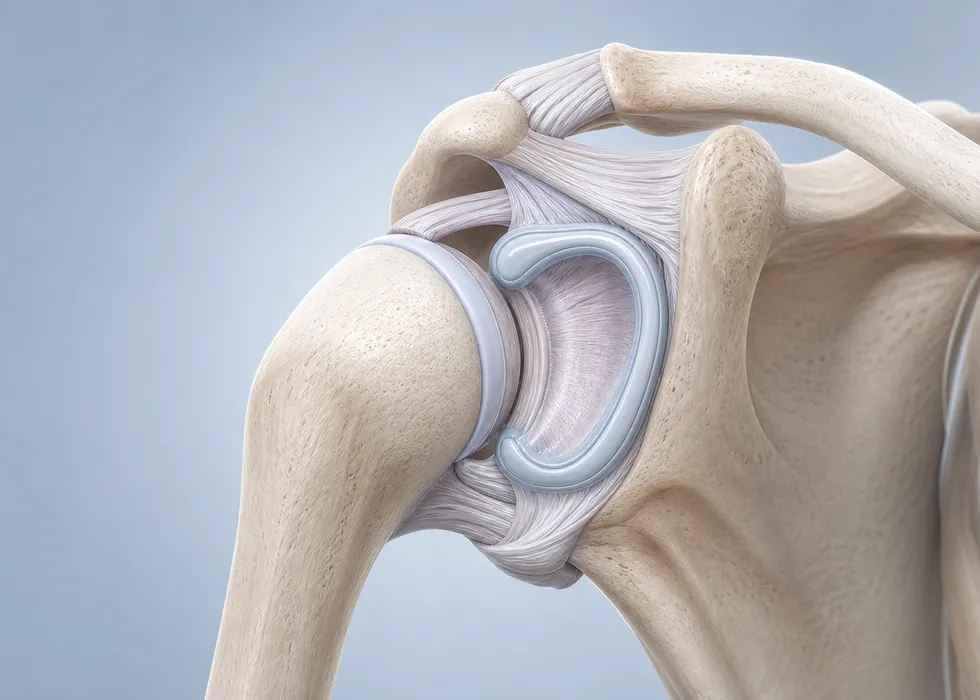
Shoulder instability refers to the inability of the glenohumeral joint to remain centered and secure during motion. Some patients experience repeated full dislocations, while others feel painful slipping, apprehension, or loss of confidence in specific arm positions.
Not Every Unstable Shoulder Is the Same
Shoulder instability can be divided broadly into traumatic and atraumatic patterns.
Traumatic instability
This usually follows a clear injury and is often associated with damage to the labrum, capsule, or bone. It is commonly anterior and may recur, especially in younger active patients.
Atraumatic or multidirectional instability
This may be related to generalized laxity, connective tissue quality, repetitive microtrauma, or poor neuromuscular control. Symptoms may be less dramatic than a full dislocation, but function can still be severely affected.
Common Symptoms
Patients may describe:
- A sense that the shoulder may slip out
- Repeated dislocations or subluxations
- Pain in positions of abduction and external rotation
- Avoidance of sport or overhead movement
- Weakness or loss of confidence
Apprehension is an important symptom. The patient may not always have pain, but feels that the shoulder is unsafe in certain positions.
Examination and Imaging
Clinical evaluation may include apprehension testing, relocation testing, translation testing, and assessment for generalized laxity. Imaging helps define the structural problem and may reveal:
- Labral tears
- Glenoid bone loss
- Hill-Sachs lesions
- Capsular laxity
- Associated cuff injury
This structural assessment is essential because treatment depends on whether the shoulder is failing because of soft tissue damage, bone loss, laxity, or a combination of factors.
Conservative Treatment
Rehabilitation is the first-line approach for many patients with atraumatic or multidirectional instability. Treatment focuses on:
- Rotator cuff strength
- Scapular control
- Proprioception
- Neuromuscular timing
- Avoiding provocative overload while control improves
Some patients improve dramatically when the shoulder gains better dynamic stability, even if the underlying laxity remains.
When Surgery Is More Appropriate
Surgical stabilization is more often considered when:
- There is recurrent traumatic instability
- Daily activity is limited by repeated episodes
- Significant labral or bony injury is present
- Rehabilitation fails to provide reliable stability
Procedures may include arthroscopic Bankart repair, remplissage, or bone-block procedures such as Latarjet, depending on the amount of bone loss and the instability pattern.
Long-Term Goal
The aim is not only to stop a single dislocation, but to restore a shoulder that is stable, functional, and dependable in daily life or sport. Accurate classification, imaging, and patient-specific treatment planning are what make that possible.